.jpeg)
Drift is why you lose money.
It's the gap between what you bid and what you're actually doing. Between what you planned and what the field is delivering. Most subs don't see it until the job is over. By then, the money's gone.
Learn the frameworkWhat is Drift?
Drift is the invisible distance between your estimate and your execution. It's the hours that pile up without anyone noticing. The scope that expands without anyone tracking. The efficiency that erodes day by day.
You bid the job at 1,200 hours. You're at 1,400 and the job's 75% done. That's Drift.
You planned for 3 guys on that phase. You've had 5 out there for two weeks. That's Drift.
The GC moved your start date twice, added work to your scope, and now you're working out of sequence. That's Drift too.
Drift doesn't announce itself. It accumulates. And by the time you notice it, you've already lost the margin.
.jpeg)
The Framework
8 Conditions for Production
Just like life requires oxygen.
Your bid assumed these conditions would exist. When they're maintained, crews produce. When they break, every hour lost is money that was never in the bid.
Access
Can physically reach the work area
Materials
Required materials staged and ready
Tools
Required tools and hand equipment
Equipment
Heavy equipment and lifts available
Information
Drawings, specs, RFIs answered
Sequence
Prior work complete and inspected
Leadership
Decisions made, direction provided
Team Size
Adequate crew for the work
When any condition breaks, production slows or stops. That lost time was never in your bid.
Not all drift is your fault.
Some broken conditions you can fix. Others were caused by someone else. BlackHyve shows which conditions broke, so you can route the problem to the right place.
Internal Drift
Problems within your control
- •Material ordering and staging
- •Crew scheduling and allocation
- •Equipment maintenance
- •Tool inventory and distribution
- •Foreman assignments and span of control
Route to:
Procurement, planning, training, equipment investment
Own it. Fix it.
External Drift
Problems caused by others
- •GC schedule changes and compression
- •Other trades not clearing areas
- •Design changes and RFI delays
- •Owner-directed modifications
- •Site access restrictions
Route to:
Partnership Notices, Change Orders, Claims
Document it. Get paid.
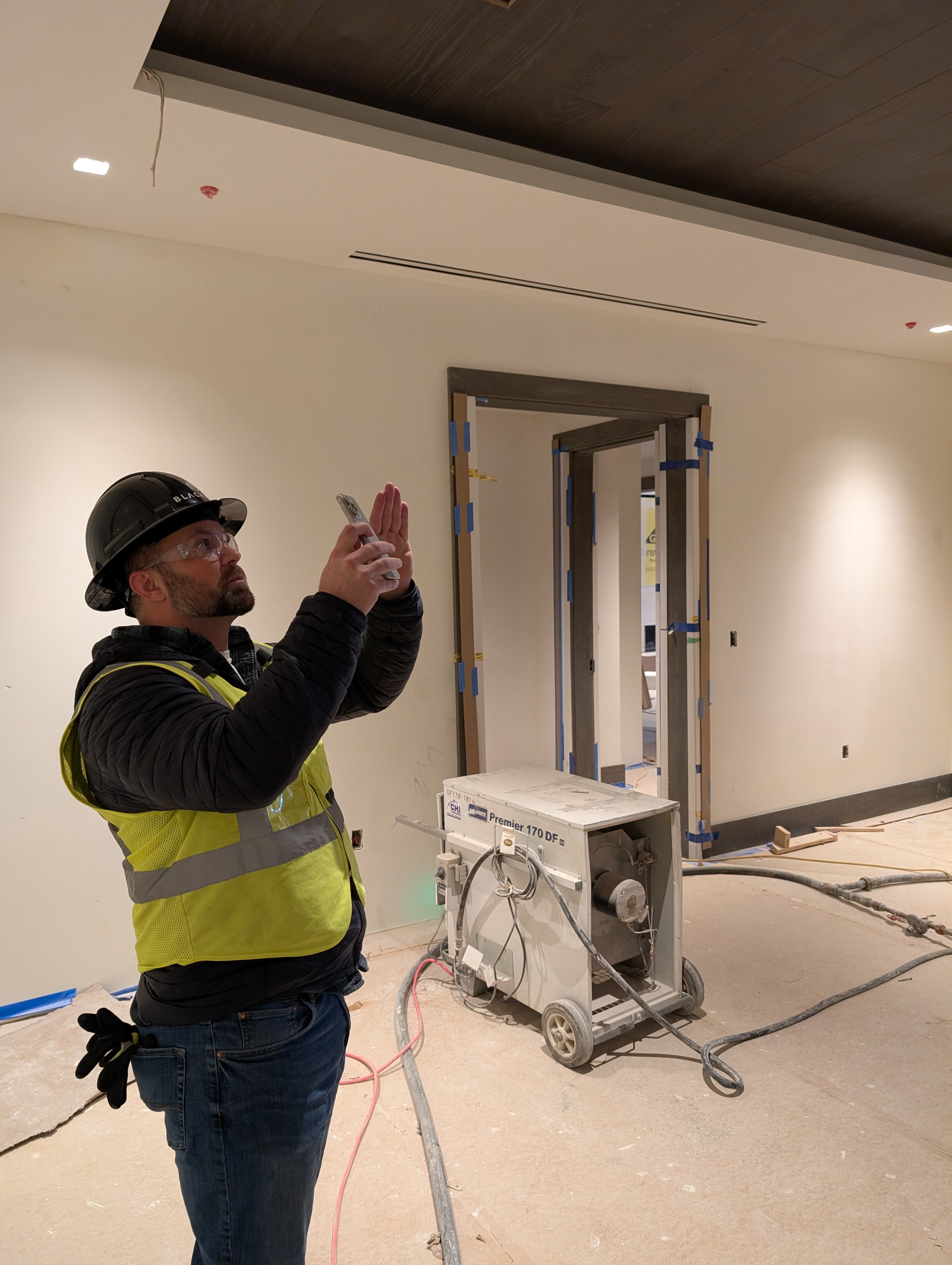
Drift starts in the field.
Your foremen see broken conditions first. They know when the area isn't ready. They know when materials are staged in the wrong place. They know when they're working out of sequence because someone else isn't done.
But that knowledge evaporates. By the time anyone writes it down — if they write it down — the details are gone. The timestamp is gone. The proof is gone.
BlackHyve captures it in the moment. Voice note. Phone. 30 seconds. Now you have a record that can't be disputed.
Why Drift is hard to see.
Drift doesn't show up in one big event. It's not a catastrophe. It's a thousand small things that don't get noticed because each one seems minor.
An extra hour here. A guy standing around there. A phase that took 10% longer than planned. None of it sets off alarms. All of it adds up.
Most subs don't have the systems to see it. Time gets logged in buckets too big to analyze. Progress gets measured by gut feel. By the time the job cost report comes in, it's history — you can't do anything about it.
You can't fix what you can't see. And Drift is designed to stay invisible.
At $95/hr burden rate, that's $63,365 walking out the door.
.jpeg)
What BlackHyve does about it.
BlackHyve makes Drift visible. We connect your estimate to your field data so you can see the gap forming — while there's still time to do something about it.
Identify Drift. Route it for action. Control your story.
See hours against estimate — live
Not at close-out. Not at the monthly review. Today. Know if you're burning faster than planned while you can still adjust.
Track broken conditions
When your crew can't produce because of access issues, material delays, or out-of-sequence work — document it. Build the case.
Route to the right action
Internal drift goes to ops. External drift builds your change order case. Same data, different destinations.
Catch problems in days
Weekly visibility means weekly course corrections. Don't wait until the job is over to learn you lost money.
Walk in with the paper
When the GC asks why you need more time or money, you have documentation. Hours. Impacts. Proof.
Capture in 30 seconds
Voice note from your phone. AI transcribes and categorizes. Your foremen already see the problem — now it's documented.
.jpeg)
Know where you stand on Drift.
Stop finding out you lost money after the job is over. See the gap while there's still time to close it.